
Hilo Hawaii Death Records
Hilo death records are filed through the Hawaii County system and the State Department of Health. If you need to find a death certificate for a Hilo resident, the State DOH Office of Health Status Monitoring handles all requests for records going back to July 1909. You can search online, send a request by mail, or visit the main office in Honolulu in person. The Hawaii District Health Office in Hilo can help you start the process and point you to the right forms and fees. Historical records dating back to the 1800s are also available through the Hawaii State Archives and several genealogy databases.
Hilo Overview
Hilo Death Records
Hilo is the county seat of Hawaii County and the largest settlement on the Big Island. The city had a population of 40,759 in the 2000 census and grew to 44,186 by 2020. It sits at roughly 19 degrees 42 minutes north latitude and 155 degrees 5 minutes west longitude, overlooking Hilo Bay with views of Mauna Loa and Mauna Kea in the distance. Death records for Hilo residents flow through the Hawaii County system and ultimately end up with the State DOH.
All death certificates in Hawaii are issued by the State Department of Health's Office of Health Status Monitoring. The Hawaii District Health Office in Hilo is the local contact point for Big Island residents. That office is located at 75 Aupuni Street, Suite 201, Hilo, Hawaii 96720, and can be reached at (808) 974-6008. Their vital statistics page is at health.hawaii.gov/big-island/home/vital-statistics/. Deaths that occur at Hilo Medical Center, the primary hospital serving the area, are reported directly to the DOH.
The legal framework for death records in Hawaii is Hawaii Revised Statutes Chapter 338. This chapter covers how death certificates must be filed, who can access them, and what fees apply. Under HRS 338-9, a death certificate must be filed within three days of the death.
The Hawaii Tribune-Herald is the main newspaper serving Hilo and the Big Island. It publishes local news including death notices and obituaries for Hilo residents.

The Hawaii Tribune-Herald covers deaths, accidents, and public safety news for the Big Island, making it a useful resource when searching for death records in Hilo.
Requesting Death Certificates in Hilo
There are three ways to request a Hilo death certificate: online, by mail, or in person. The online portal at vitrec.ehawaii.gov/vitalrecords/ covers records from July 1909 to the present. It is the fastest option and lets you pay by credit card. Once you submit your order online, you can schedule a pickup appointment at a district health office if you prefer not to wait for mail delivery.
Big Island residents who want to pick up their order locally should note that the nearest pickup location is the Kamuela District Health Office, not the Hilo office. That office is at 67-5189 Kamamalu Street, Kamuela, HI 96743, phone (808) 887-8114. Hours are Monday, Wednesday, and Friday from 9:00 a.m. to 2:00 p.m. by appointment only. You must place and pay for your order online before scheduling pickup. Walk-ins are not accepted.
If you prefer to mail your request, send it to the State Department of Health at P.O. Box 3378, Honolulu, HI 96801. Mail payment must be a cashier's check, certified check, or money order. Cash and personal checks are not accepted for mail requests. Processing by mail takes six to eight weeks. Big Island residents who travel to Oahu can also visit the main office in person at 1250 Punchbowl Street, Room 103, in Honolulu.
Fees are set under HRS 338-14. The first copy costs $10. Each additional copy of the same record ordered at the same time is $4. There is a $2.50 portal fee for online orders. In-person payments at the Honolulu office can be made by cash, credit card, cashier's check, or money order. All fees are non-refundable.
Access to death certificates is restricted under HRS 338-18. You must show a direct and tangible interest in the record. Eligible parties include the spouse, parents, descendants, siblings, grandparents, legal guardian, or representative of the estate. A court order can also authorize access. Required identification includes a driver's license, state-issued ID, US passport, foreign passport, or US military ID along with proof of your relationship to the person named on the certificate.
Note: The online portal is available around the clock, but processing and pickup scheduling follow State DOH business hours.
Death Investigations in Hilo
Hawaii Island police handle death investigations on the Big Island. When an unexpected or violent death occurs in Hilo, officers respond, secure the scene, and start an inquiry. If the cause of death is not clear, an autopsy is ordered. The medical examiner system then works with the State DOH to issue the death certificate. Under HRS 338-9, if the cause is still unknown when the certificate must be filed, it can be listed as "pending investigation" and amended later.
One example from early 2026 shows how this process works. A 20-year-old Hilo man died in a solo crash on Mahiai Street near Ahuna Road. His vehicle, a 2017 Jeep Renegade, went off the right shoulder, struck a rock pile, and flipped. He was pronounced dead at 2:20 p.m. An autopsy was ordered to confirm the cause of death. That crash was Hawaii County's first traffic fatality of 2026. For incident information, the public contact was Officer Jerome Duarte at (808) 961-2339 or Jerome.Duarte@hawaiicounty.gov. Crime Stoppers for the Big Island can be reached at (808) 961-8300.
When a death investigation is open, the full death certificate may not be available right away. The record is filed with limited information first and updated once the examiner completes the review. This can take weeks or months in complex cases involving toxicology testing.
Hilo-area community information and historical background can be found through resources like fact-index.com, which covers demographics and settlement history for the area.
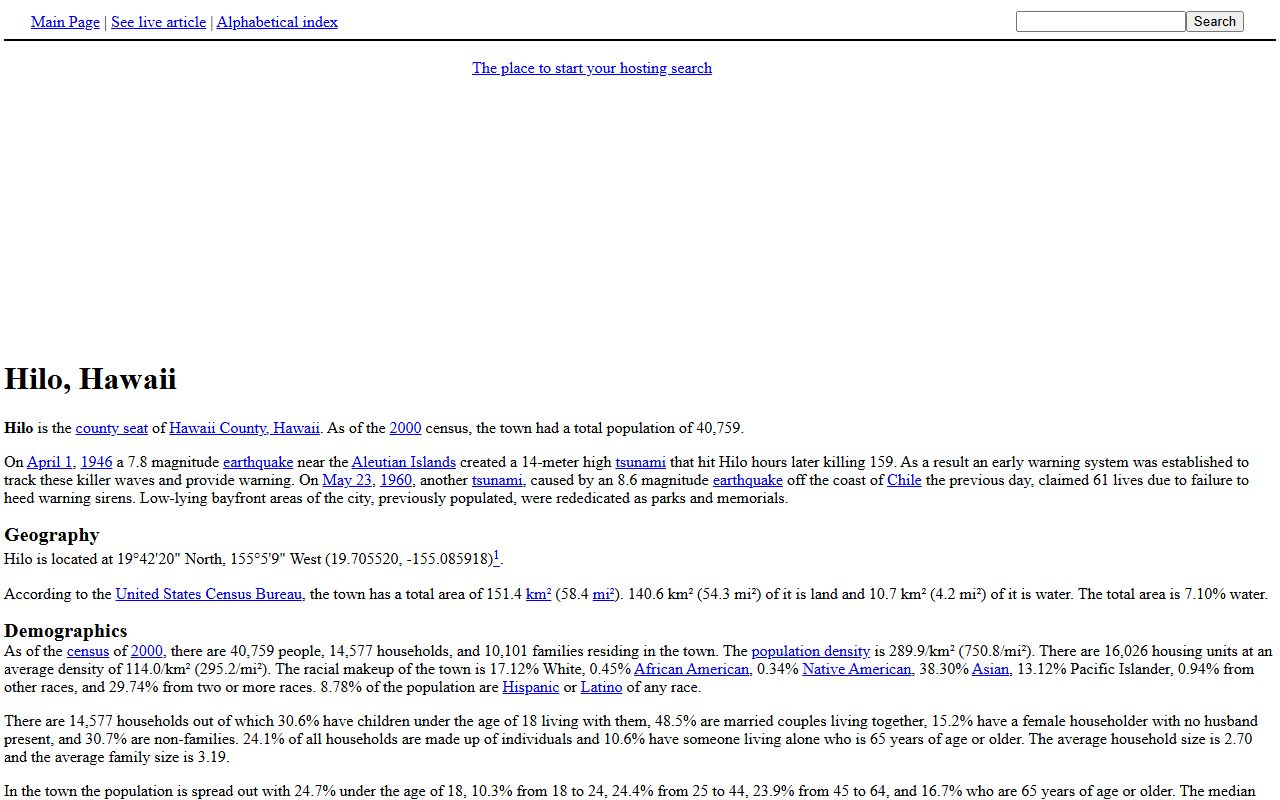
Background on Hilo's population, geography, and history can help researchers place death records in proper context when working through Big Island genealogy projects.
Historical Hilo Death Records
Hawaii County death records go back to 1841. For genealogy work, this depth of coverage makes the Big Island one of the better-documented places in the Pacific. Records from 1853 to 1896 are held at the Hawaii State Archives, where Big Island entries are designated with the letter H. The archive maintains a research guide at ags.hawaii.gov, and digital images can be searched through the Hawaii Digital Archives.
For the period from 1896 to 1903, the Hawaii District Health Office maintained death register indexes organized by island. Hawaii Island reports of vital statistics from 1851 to 1896 are also available. The Hawaii State Library's Hilo branch at 300 Waianuenue Avenue carries vital records indexes through 1909 and can assist researchers looking for early Hilo death entries.
Free online databases are a good first stop for genealogy searches. FamilySearch has an index with images covering 1841 to 1925 Hawaii Death Records and Death Registers. Ancestry carries Hawaii Death Certificates from 1841 to 1942. Both sites let you search by name and provide scanned images of the original documents when available. Cemetery resources such as BillionGraves, Find a Grave, Hawaii HI GenWeb, Interment.net, and the USGW Tombstone Project may also help confirm names, dates, and burial locations for Hilo residents.
The Hawaii County Courthouse at 777 Kilauea Avenue, Hilo, HI 96720, phone (808) 961-7440, holds court records that may contain death-related legal filings such as probate and estate cases. These can supplement vital records research when a death certificate alone doesn't answer all your questions.
For Big Island news coverage, the Go Hawaii page for Hilo provides background on the community that can be useful when placing historical records in context.

The Hilo area on the Big Island has a long recorded history going back to the Kingdom of Hawaii, making it one of the richer sources for historical death records in the state.
Note: Records from before 1909 are held at the State Archives and are not available through the online vital records portal.
Hilo Genealogy and Death Research
Genealogy requests for events that happened 115 or more years ago follow a different process. The DOH has a dedicated genealogy page at health.hawaii.gov/vitalrecords/genealogy/ where older records can be requested. These records have fewer access restrictions than recent ones since the individuals are presumed to be deceased.
Before you make a request, gather as much background as you can. Name, date of death, place of death, and parents' names all help the DOH locate the right record. If you don't have these details, obituaries in the Hawaii Tribune-Herald and cemetery indexes are often a good starting point. The University of Hawaii at Manoa library has a guide for Hawaii vital records research at guides.library.manoa.hawaii.edu.
If you need a death record for a legal purpose but can't get a full certified copy, HRS 338-14.3 provides for a verification letter. This letter confirms that a record exists and states the basic facts without disclosing the full contents. It can be used for many legal and administrative purposes when a certified copy isn't strictly required.
Legal Aid Hawaii at legalaidhawaii.org offers free help to qualifying residents who need death records for estate or legal matters. For third-party certificate ordering, GoCertificates provides an alternative ordering service for Hawaii vital records.
Hawaii County Death Records
Hilo is the county seat of Hawaii County, which covers the entire Big Island. All death records for Hilo residents are processed through the Hawaii County system and the State DOH. For more on county-level resources, court information, and other offices that handle death records on the Big Island, see the Hawaii County page.
Other Big Island Communities
Hilo is the only Big Island city that qualifies for its own records page on this site. Other communities on the island, including Kailua-Kona, Waimea, Pahoa, and Captain Cook, are served by the same Hawaii County system. Death certificate requests for residents of those areas follow the same process described above.