
Find Death Records in Hawaii
Hawaii death records are held by the State Department of Health and cover events from 1896 to the present. You can search for and request certified copies online, by mail, or in person at the Honolulu vital records office. Whether you need a death certificate for legal purposes or you are tracing family history in Hawaii, this guide explains who can request records, what the process looks like, what it costs, and where to find older records that predate the modern system.
Hawaii Death Records Overview
Where Hawaii Death Records Are Kept
The Hawaii State Department of Health, Office of Health Status Monitoring, maintains all death certificates for events that occurred in Hawaii. Their office is located at 1250 Punchbowl Street, Room 103, in Honolulu, on the first floor of the main health building at the corner of Beretania and Punchbowl Streets. Death records from 1896 to the present are on file here. Registration of deaths was first required by state law in 1859, though few records exist before the Department of Health took over in 1896. If you need a certified copy of a Hawaii death certificate, this is the only state office that issues them.
Hawaii uses a centralized system. There is no county-level issuing office for death certificates. It does not matter whether the death took place in Honolulu, on Maui, on the Big Island, or on Kauai. All certified copies come from the one state office. Neighbor island residents can still use the online system or call for help. The Kauai District Health Office can assist residents at (808) 241-3498. For Hawaii Island, reach the Hilo office at (808) 974-6008. The Maui District Health Office in Wailuku can also give guidance, though it does not issue certificates directly.
The main Honolulu office is open Monday through Friday, 7:45 a.m. to 2:30 p.m. It closes on all state holidays. Metered parking is available in front of the building from Punchbowl Street at $2 per hour. Appointments are encouraged, but walk-in service is available between scheduled visits.
The Hawaii Department of Health Vital Records homepage provides contact information, office hours, forms, and links to the online ordering system for all types of vital records including death certificates.
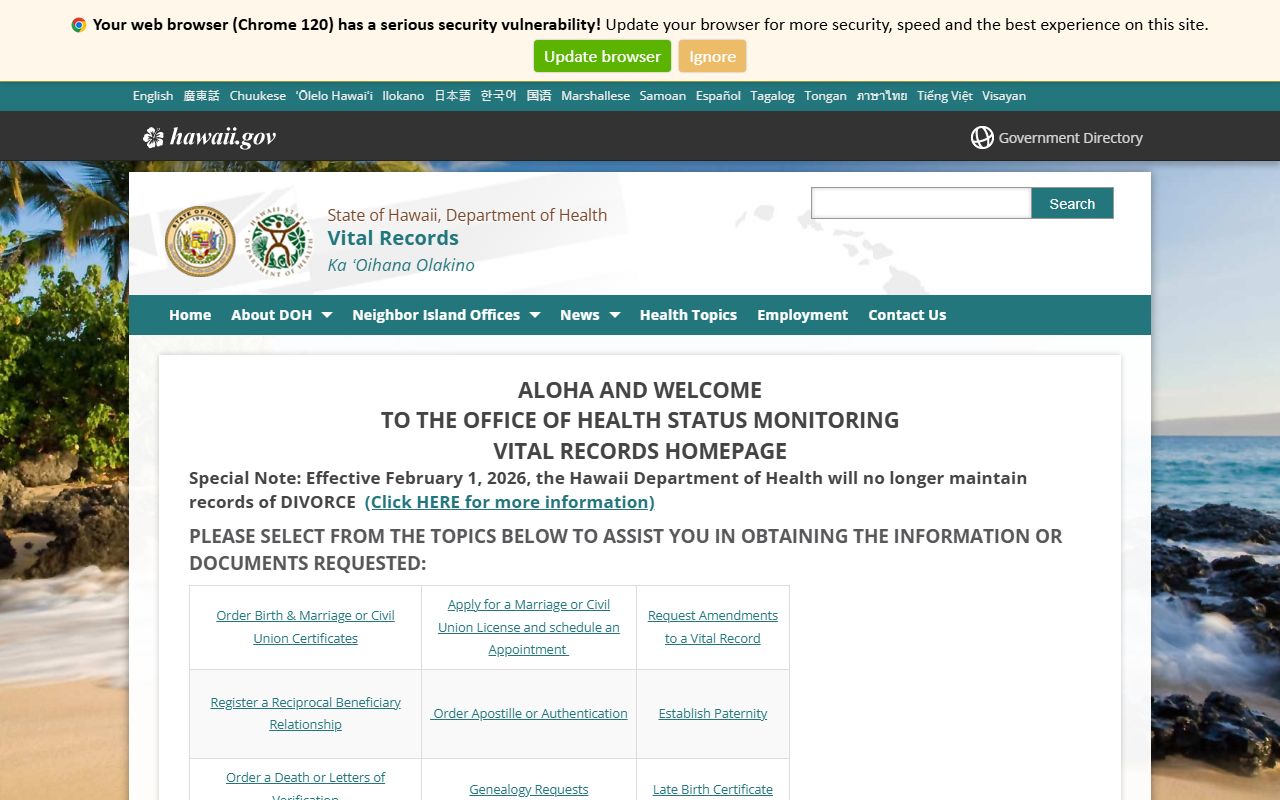
The office handles online orders for records dating from July 1909 to the present, while the Hawaii State Archives holds the older collections for events before that date.
How to Request Hawaii Death Records
There are three ways to get a certified copy of a death certificate in Hawaii. Online ordering through vitrec.ehawaii.gov is the most common method. You create a free eHawaii account, fill out the request form, upload a copy of your government-issued photo ID along with any documents proving your eligibility, and pay by debit or credit card. The online system covers records from July 1909 to the present. If you log in rather than order as a guest, you can check your order status in the My Orders section and reorder more easily down the road. Average mail delivery time from the online system is currently 6 to 8 weeks.
Mail requests are an option for those who prefer not to use the online portal. Download the official request form from the DOH death certificates page, attach a legible copy of your government-issued photo ID, and include any documents that establish your relationship to the deceased. Send everything with payment to: State Department of Health, Office of Health Status Monitoring, Issuance/Vital Statistics Section, P.O. Box 3378, Honolulu, HI 96801. For mail orders, payment must be by cashier's check, certified check, or money order payable to the Hawaii State Department of Health. Cash and personal checks are not accepted by mail under any circumstances.
In-person requests are handled at 1250 Punchbowl Street, Room 103. Bring the completed form, your photo ID, proof of eligibility, and payment. The office accepts cash, credit card, cashier's check, certified check, and money orders in person. Same-day service may be possible when the record is on file and your documents are all in order. The form directs you to call (808) 586-4539 or (808) 586-4542 with questions, or to email doh.issuanceQuery@doh.hawaii.gov.
Under Hawaii Revised Statutes Section 338-9, whoever is in charge of the disposition of the body must file a death certificate with the department within three days after the death. If the cause of death cannot be confirmed within three days, the certificate is filed with the notation "pending investigation." A supplemental report is filed as soon as the final cause is determined, as required by HRS Section 338-10. These requirements ensure that records are filed quickly and updated accurately.
The Hawaii DOH Death Certificates page lists all three request methods, current fees, office hours, required documents, and links to the request form and online ordering system.
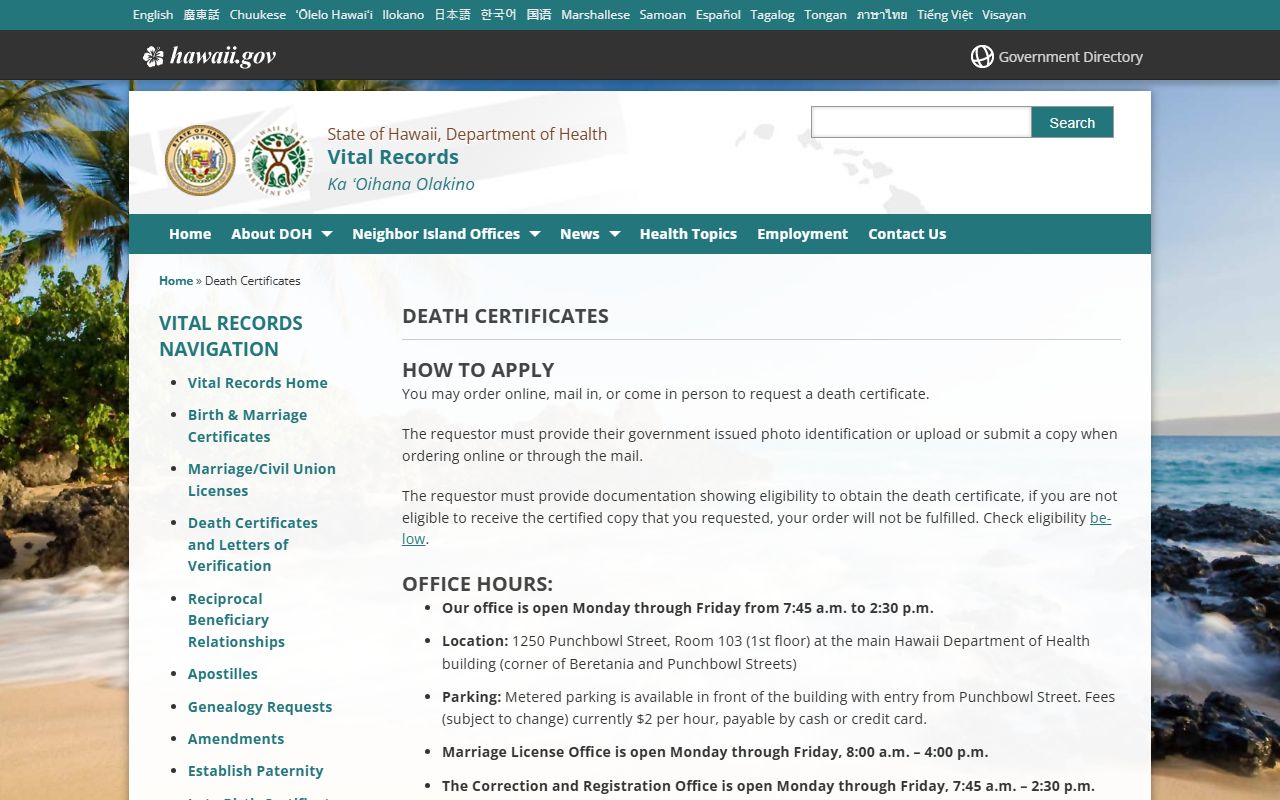
Any order that lacks proper ID or proof of eligibility will be held by the office until all required materials are received, which can delay processing significantly.
Hawaii Death Certificate Costs
The fee for a certified copy of a Hawaii death certificate is $10 for the first copy and $4 for each additional copy of the same record ordered at the same time. This fee structure is established under HRS Section 338-14. Online orders through the state portal add a $2.50 administration fee for each group of up to five certificates. A single certificate ordered online costs $12.50 total. Two copies of the same record cost $16.50. Six copies cost $32.50 because the $2.50 fee applies again for the second group of up to five. All fees are non-refundable. If the requested record is not found after a search is conducted, the fees are still kept to cover the cost of the search.
Only one name is allowed per request form. If you need records for more than one person, you must submit a separate form and payment for each. After a request is submitted, you also need a new request if you want more copies. The form cannot be amended after submission.
For genealogy requests involving records from events more than 115 years ago, the same fee schedule applies. Those requests are processed through a separate appointment system and are not treated as priority requests.
Services like GoCertificates Hawaii help process requests for certified copies through the state Department of Health system, applying the same eligibility rules and fee schedule as a direct request.
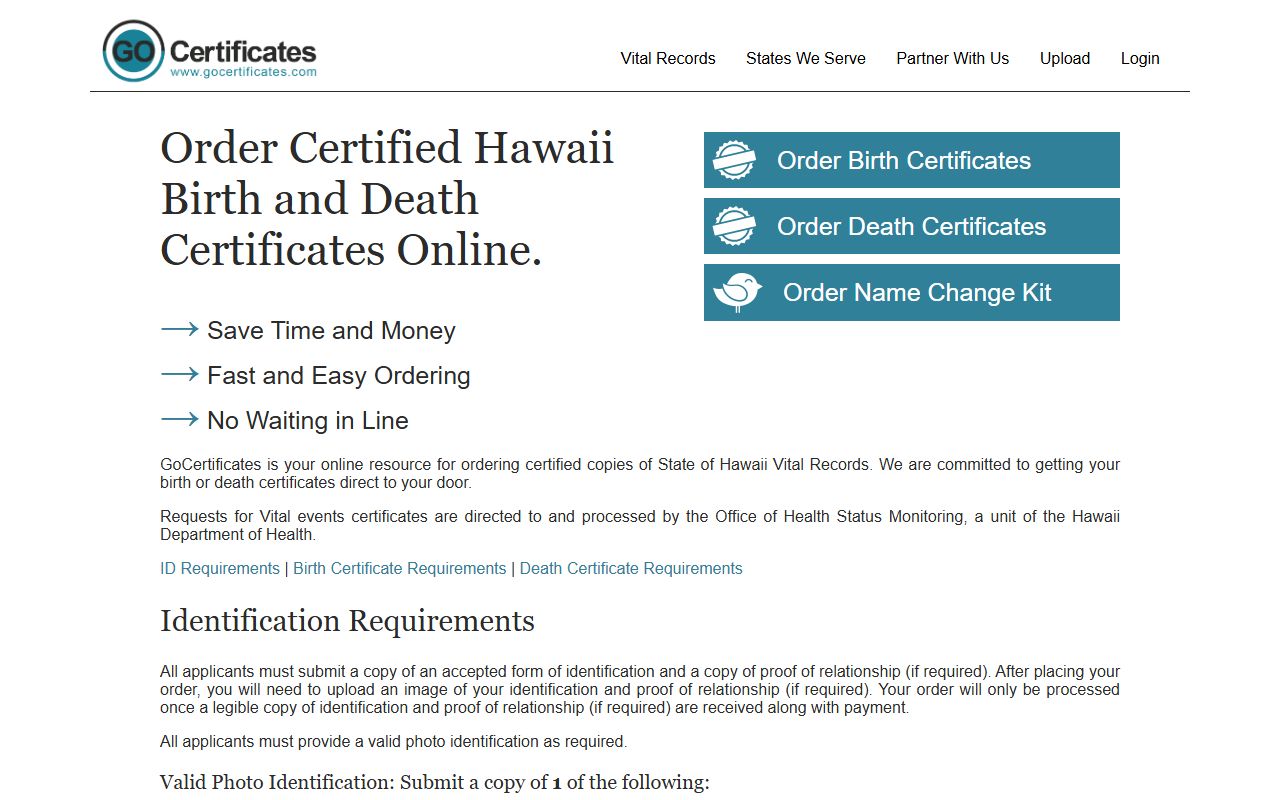
Third-party ordering services route your application to the Office of Health Status Monitoring, so processing times and fees are the same as going directly through the state.
Who Can Request a Hawaii Death Record
Hawaii death records are not open for public inspection. Under HRS Section 338-18, certified copies are issued only to those who have a direct and tangible interest in the record. The law lists specific categories of eligible persons. These include the registrant's spouse, parents, children, grandchildren, siblings, grandparents, aunts, uncles, and cousins. Legal guardians, personal representatives of the estate, people with a court order, and persons acting on behalf of the registrant also qualify.
Several less common situations also meet the standard. A person who needs to confirm the death of a non-related co-owner of jointly held property can apply. So can someone who needs the record to determine payments under a credit insurance policy, or someone verifying the marital status of a former spouse for alimony purposes. Adoptive parents who need to establish the death of a prospective adoptee's natural parents are also eligible. Funeral directors handling the case can obtain records with appropriate authorization.
All applicants must submit a copy of valid government-issued photo ID. Acceptable forms include a state driver's license or ID card, a U.S. passport, a foreign passport, or a U.S. military ID. If you are requesting on behalf of an eligible person, you need additional documentation showing your authority to act. Requests that arrive without proper ID and proof of eligibility will not be processed.
Searching Historical Hawaii Death Records
For events that took place more than 115 years ago, you can make a genealogy appointment with the Department of Health to submit your request in person. The DOH Genealogy Requests page explains the process. These requests are not urgent and are processed separately from standard vital records requests. Fees are the same as certified copies. Genealogy appointments allow you to look for records of older deaths that are still within the DOH collection but fall outside the standard online ordering window.
The Hawaii State Archives Vital Statistics Collection is the main resource for records that predate the modern system. This collection holds death reports and registers from the 1800s through 1929 for most islands. Records are arranged by island and then alphabetically by name. Two sets of indexes exist for this collection: one covering 1832 to 1910 and another covering 1911 to 1929. Both are in the Archives reference room and are also accessible online through the Ulukau Hawaiian Electronic Library. The Archives notes that registration was seriously under-reported in the early years, so gaps in the record are common.
Several free online databases can help with older Hawaii death records research. FamilySearch has a Hawaii Death Records and Death Registers collection spanning 1841 to 1925, with images. There is also a Hawaii Deaths and Burials index from 1862 to 1919. For more recent research, the Hawaii Obituaries Index on FamilySearch covers roughly 1980 to the present. Hawaii death records from 1841 to 1942 are also available at Ancestry.com with images and an index. If you do not know the exact date or place of death, the U.S. Social Security Death Index covering 1935 through 2014 can help narrow things down.
The Hawaii State Archives Digital Collections site provides free online access to digitized vital statistics, probates, wills, divorce case files, obituary indexes, and naturalization records. The digital collection spans the Kingdom and Territory periods. If you visit the Archives in person, you can use microfilm readers, a scanning station, and computer stations. Visitors must register at the circulation counter and present valid ID. Some materials are only on microfilm due to fragile condition.
The Hawaii State Archives Vital Statistics Collection contains death reports, marriage licenses, and related records from the Kingdom of Hawaii era, organized by island and accessible through the Archives and its digital portal.
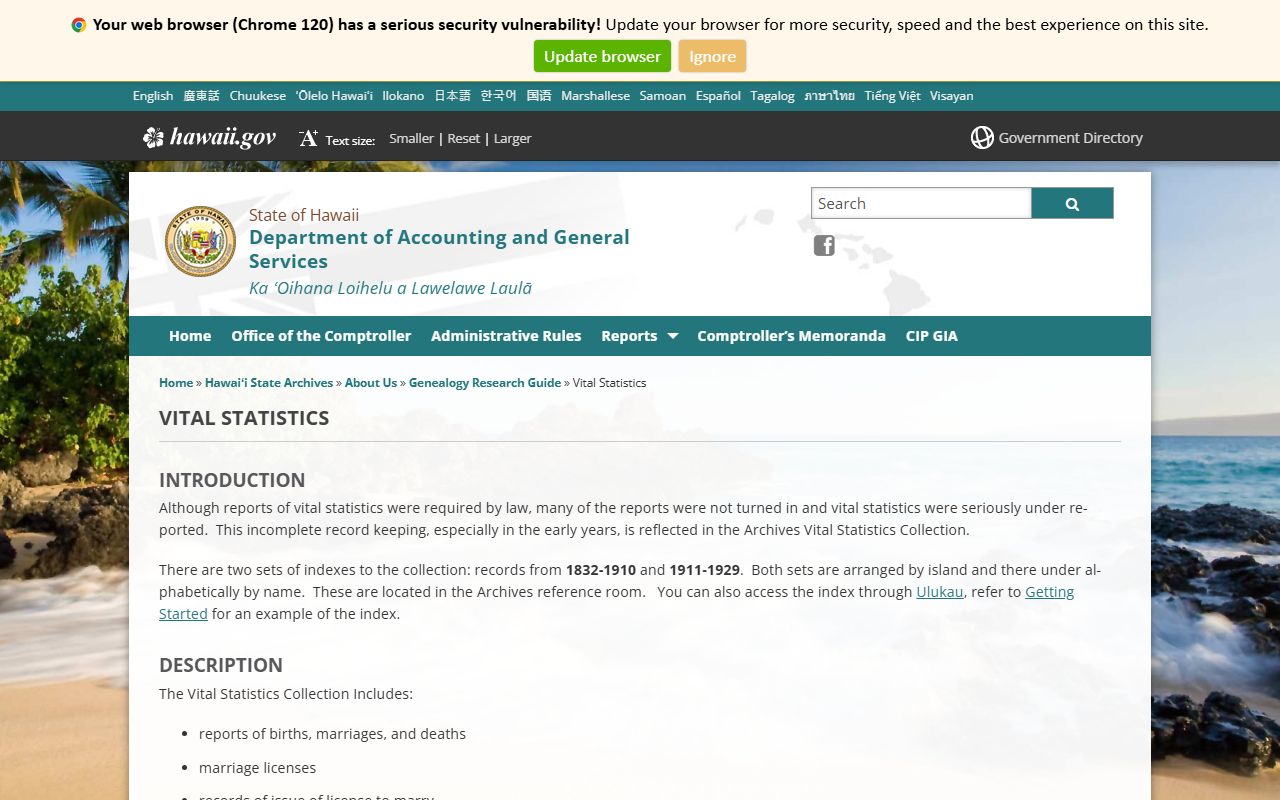
Island designations in the records use letters: H for Hawaii Island, K for Kauai, M for Maui, Mo for Molokai, and O for Oahu, helping researchers narrow down which island the record came from.
The Hawaii State Archives Digital Collections project preserves historical government records online, including vital statistics, ships manifests, probates, and an obituary index covering multiple islands and time periods.
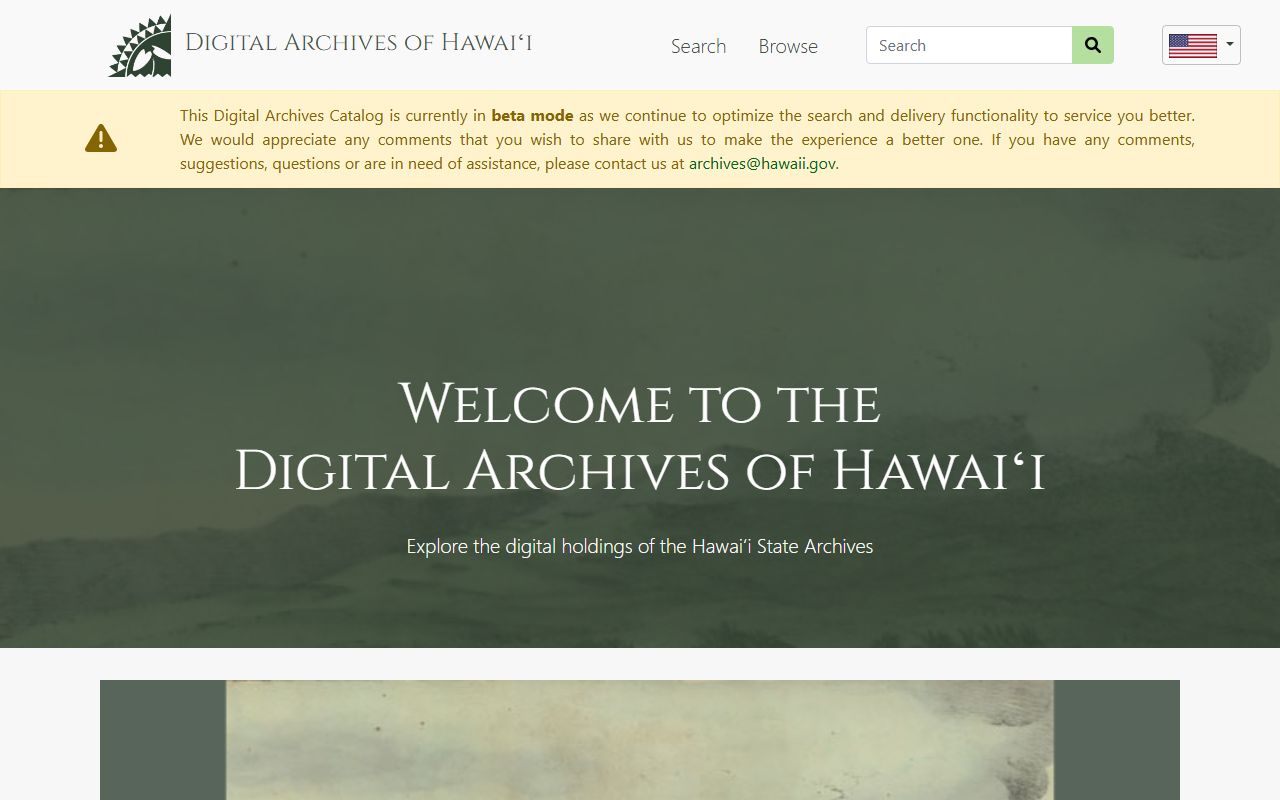
The digital repository protects records from loss and technological obsolescence, giving long-term public access to materials that once required an in-person visit to the Archives reading room.
What Hawaii Death Records Show
A modern Hawaii death certificate includes the name of the deceased, date and place of death, date and place of birth, age at death, occupation, marital status, parents' names (including the mother's maiden name), place of burial, and the cause and manner of death. The cause of death is listed by the attending physician or, in cases that come under the medical examiner's jurisdiction, by the medical examiner after investigation. The Honolulu Department of the Medical Examiner handles violent deaths, sudden unexpected deaths, and cases where a physician did not attend the patient before death. In the 2020-2021 reporting year, the Honolulu Medical Examiner accepted 1,242 death cases, performed 433 autopsies, and conducted 864 toxicology tests. Cases accepted included natural deaths, accidents, suicides, homicides, and undetermined causes.
Older death records contain less detail. Records from the late 1800s and early 1900s sometimes list only the name, date, and place of death with minimal additional information. The completeness depends on when and where the record was created. Death information found in older certificates includes the name of the deceased, date of death, place of death, date or age at birth, place of birth, place of burial, parents' names, occupation, and marital status, but not all fields appear in every early record.
Hawaii Death Records Laws
All vital records law in Hawaii is in Hawaii Revised Statutes Title 19, Chapter 338. This chapter governs the registration, amendment, disclosure, and fee structure for all vital records including death certificates. HRS Section 338-8 establishes the legal requirement to register all deaths and fetal deaths. HRS Section 338-9 sets the three-day filing deadline and identifies who is responsible for filing. HRS Section 338-10 covers the process for cases where the cause of death cannot be determined within that window.
Access to records is governed by HRS Section 338-18, which restricts inspection of vital records to those with a direct and tangible interest. The Public Health Regulations under Chapter 8B expand on this, specifying that vital records are not available for public inspection and that researchers who receive data for statistical purposes cannot identify individuals by name, contact persons listed on certificates, or share information in ways that violate privacy. HRS Section 338-14.3 allows the department to issue a letter of verification in place of a certified copy when a full certificate is not required.
Under HRS Section 338-18, the department may also furnish information from a record to a government agency, a hospital, or a research institution for statistical or public health purposes. Those requests must be made in writing and must explain the purpose of the study. The restrictions protect the integrity of the system while allowing legitimate research access.
The Hawaii Revised Statutes Chapter 338 governs vital statistics in the state, covering everything from filing deadlines and fees to who may inspect records and what penalties apply for misuse.
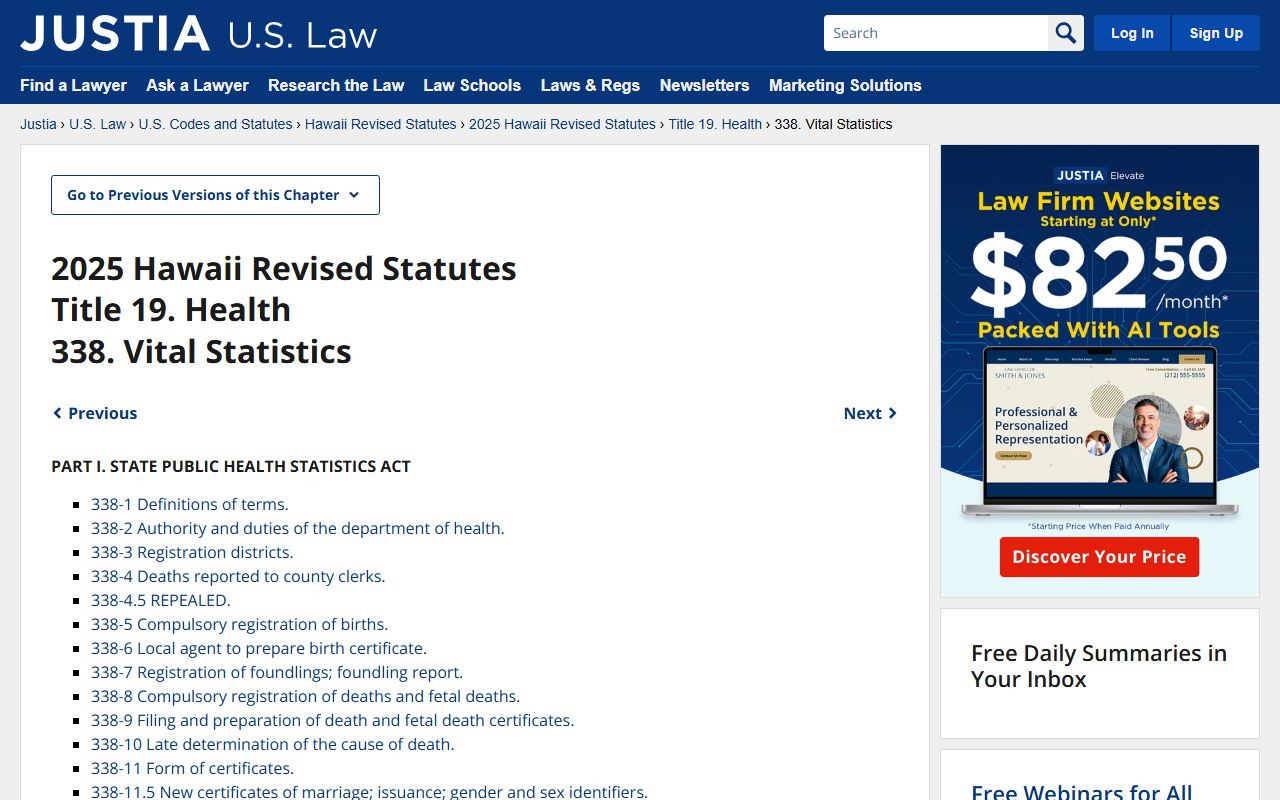
Chapter 338 has been the legal foundation for Hawaii's vital records system since statehood, and it continues to set the framework for how death certificates are created, corrected, and released to eligible requestors.
The Hawaii DOH Genealogy Requests page outlines the appointment process for requesting records older than 115 years, with the same fee schedule as standard certified copies but a longer, non-priority processing timeline.
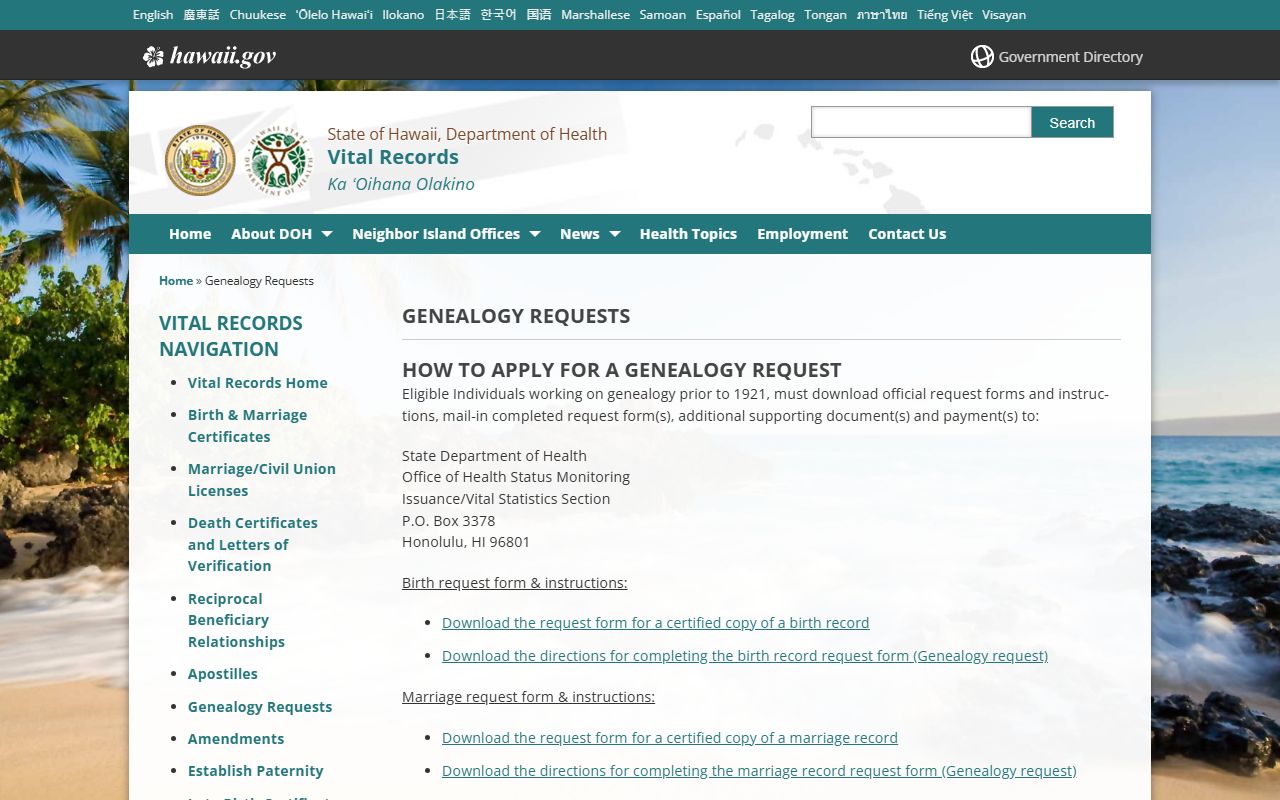
Genealogy appointments are separate from the standard vital records window and are designed for researchers who need records tied to events from the Kingdom or early Territory era.
Research Tools for Hawaii Death Records
The Ulukau Hawaiian Electronic Library provides free access to digitized indexes covering deaths, probates, and wills from the Kingdom of Hawaii era. The indexes run from 1826 through 1929 and are organized by island. Each entry points to a reference number that corresponds to a record at the Hawaii State Archives, making it easier to locate originals. The library also includes indexes for marriages, divorce court records, and citizenship records from the same period.
The Hawaii State Library system is another strong resource. The main branch at 478 South King Street in Honolulu holds the Vital Statistics Collection finding aids, death certificate indexes for 1909 to 1949 on microfilm, and newspaper obituary indexes covering publications from 1835 to 1994. Branch libraries in Hilo, Kahului, Kaneohe, Lihue, and Kailua-Kona also carry birth and vital records indexes through 1909. The UH Manoa Library genealogy guide details all of these collections and explains how to access them online or in person.
Cemetery records are also useful when death dates are unknown. The Hawaii State Archives and the Hawaii State Library maintain cemetery directories for all islands. The Hawaiian Collection at UH Manoa holds a full set of island cemetery indexes. Transcriptions from specific cemeteries are also available through BillionGraves, Find a Grave, and Interment.net. These resources can provide burial dates and locations, which in turn help you pin down the death record you are looking for.
The Ulukau Hawaiian Electronic Library hosts digitized indexes to deaths, probates, and wills from the Kingdom era, giving free online access to reference numbers that point to original records held at the Hawaii State Archives.
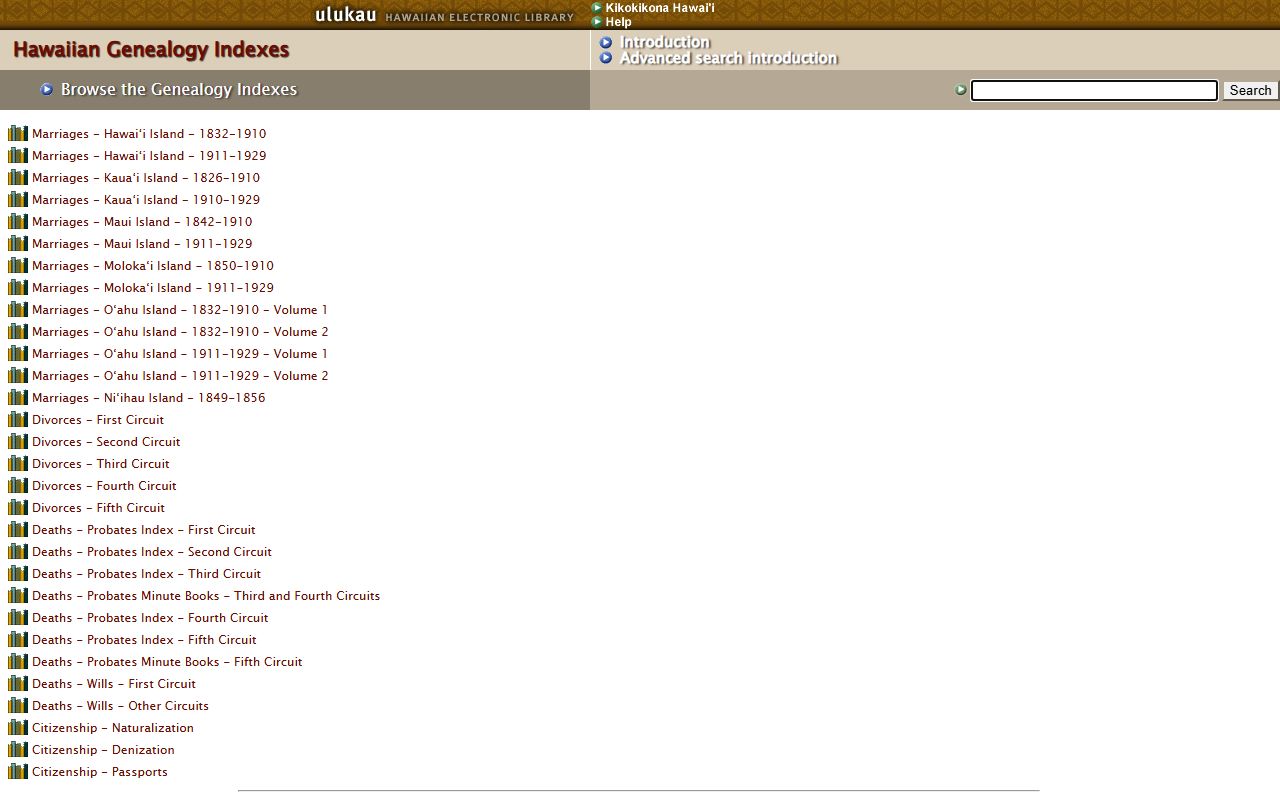
The Ulukau collection is keyword searchable and covers records from multiple islands, making it one of the most useful free starting points for researching pre-1930 Hawaii deaths.
The University of Hawaii at Manoa Library genealogy research guide lists major collections, obituary indexes, cemetery directories, and research databases for Hawaii death records research across all islands and time periods.
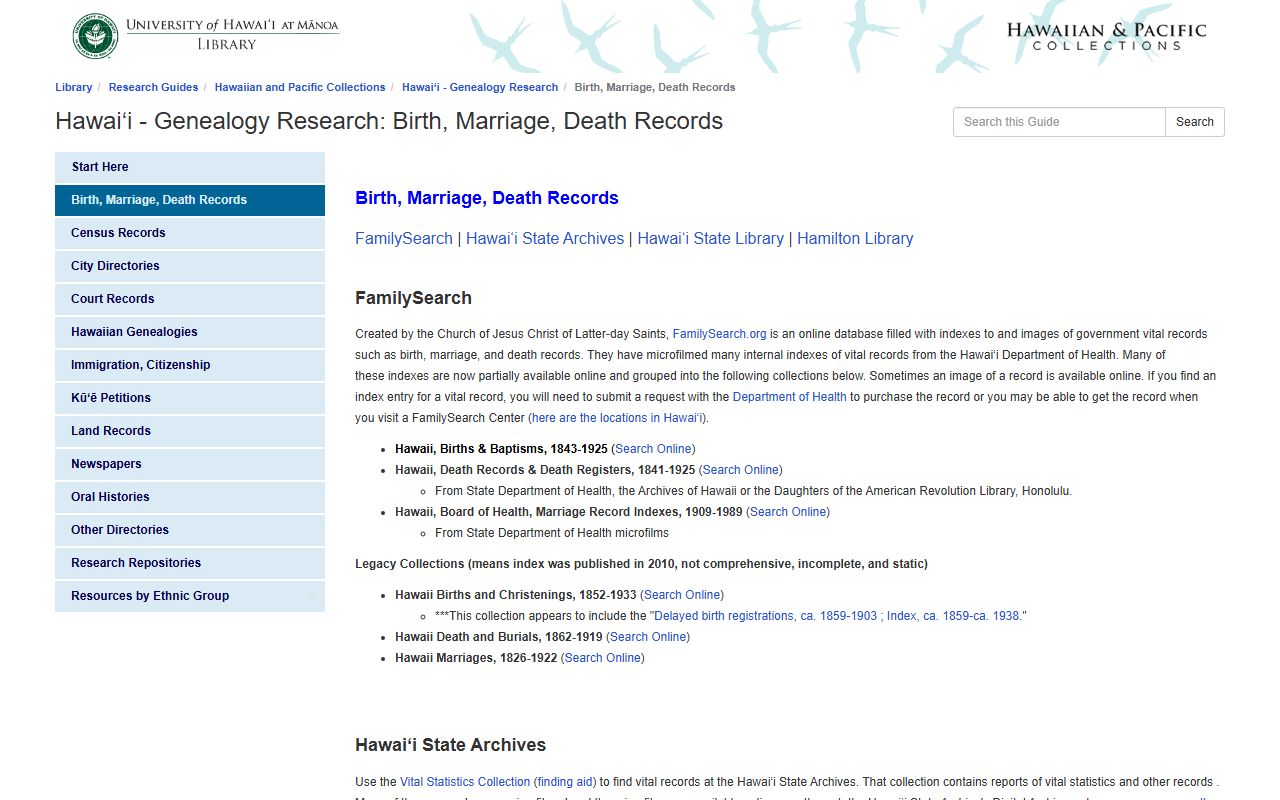
The Hawaiian Collection at UH Manoa holds cemetery indexes for all islands, which researchers can use to find burial information when official death records are incomplete or unavailable.
Browse Hawaii Death Records by County
Hawaii has five counties. Death certificates are issued at the state level, but each county has a district health office to assist residents with questions and certain vital records functions. Select a county to find local contact details and specific resources.
Death Records in Major Hawaii Cities
Select a city below to find local information on obtaining death records, nearby vital records offices, and resources specific to that area.